Musk loses case against OpenAI
Trial was culmination of years of animosity over company's mission.
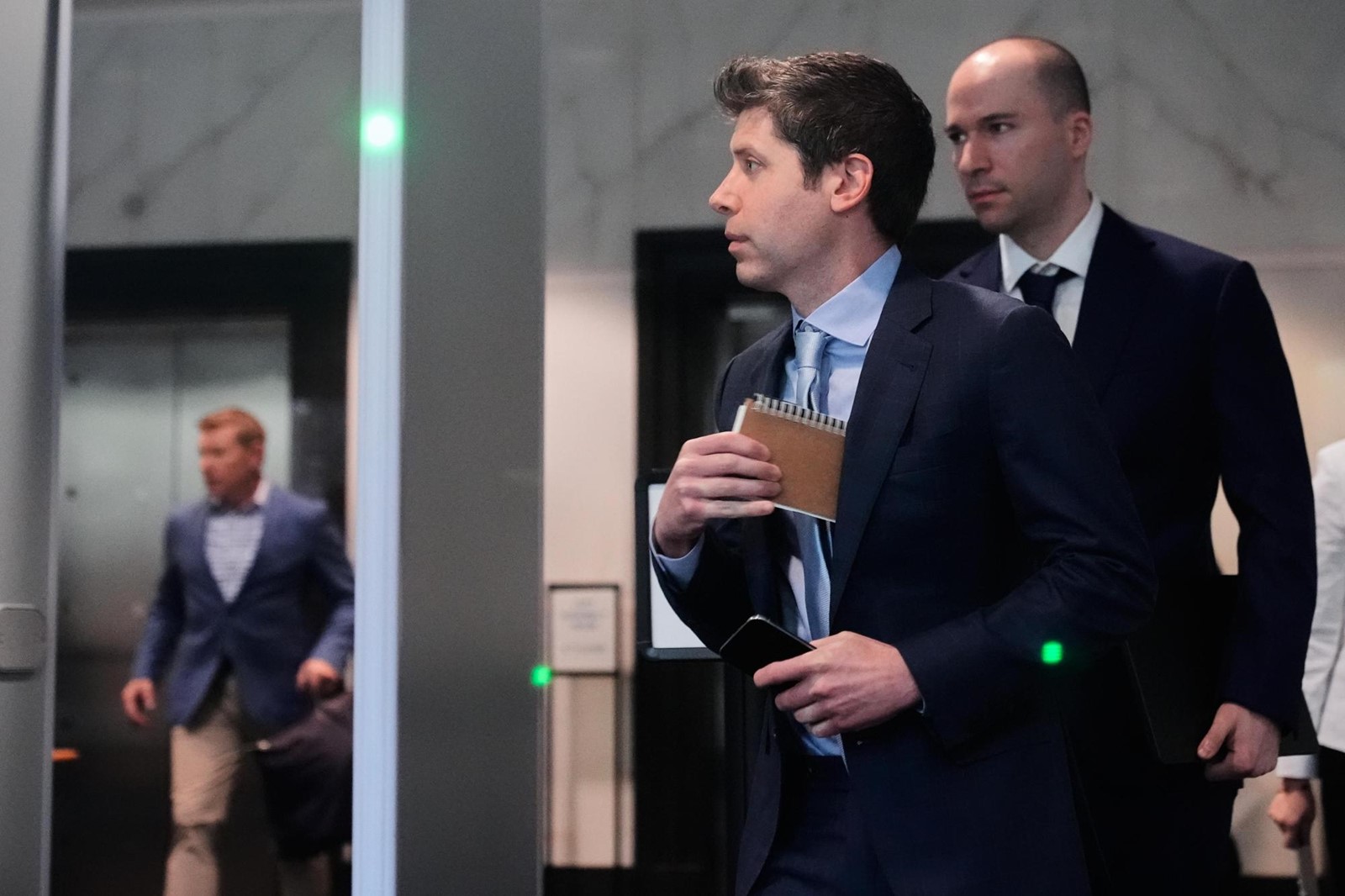
Sam Altman, center, and OpenAI president Greg Brockman, right, arrive at the U.S. District Court in Oakland April 30. A jury rejected Elon Musk's claims against Altman on Monday. Godofredo A. Vasquez - AP FIBy
By Madlin Mekelburg and Isaiah Portiz | BLOOMBERG
A jury rejected Elon Musk's claims that OpenAI under Sam Altman's leadership betrayed its mission to benefit the public by morphing into a for-profit business, finding that he waited too long to sue the company.
The verdict reached Monday in federal court in Oakland follows a trial over the bitter feud between the entrepreneurs who worked together to launch the startup in 2015. OpenAI has since evolved into one of the world's most valuable and powerful artificial intelligence companies.
"I think there is a substantial amount of evidence to support the jury's findings," U.S. District Judge Yvonne Gonzalez Rogers said when she accepted the nine-member jury's unanimous conclusion after about two hours of deliberations.
The high-profile trial, in a case that has captivated Silicon Valley since Musk filed his complaint in 2024, was the culmination of years of animosity between the OpenAI co-founders.
"The finding of the jury confirmed that what this lawsuit was is a hypocrite's hypocritical attempt to sabotage a competitor and to overcome a long history of very bad predictions about what OpenAI has been and will become," OpenAI attorney William Savitt told reporters.
Musk's lawyers vowed an appeal but didn't get into specifics about what they will argue.
Musk generally has a strong record in court battles but has had a couple of significant setbacks in the past year. Tesla, his electric vehicle company, was hit with a $243 million verdict in August over a fatal crash, and Musk faces a tab of as much as $2.6 billion after he lost a trial in March in a case brought by Twitter Inc. investors.
The jury in Oakland concluded that Musk had enough knowledge about his claims years ago that he should have sued sooner than 2024. As a result, the panel did not address Musk's central claim that OpenAI abandoned its responsibilities to develop AI for the benefit of humanity by pivoting to maximize commercial profits.
Jurors heard testimony over almost three weeks from Musk, Altman, OpenAI President Greg Brockman and other VIPs who had a front-row view of their falling out starting almost a decade ago.
The jury also saw hundreds of private message exchanges, journal entries and corporate documents that gave rarefied access to the tumultuous inner workings of the ChatGPT maker over the past 11 years as it evolved from a scrappy startup into an almost trillion-dollar company.
Musk and OpenAI painted vastly different pictures of that transformation over the course of the trial.
Musk's legal team said Altman and Brockman "stole a charity" when they decided to restructure OpenAI into a for-profit business. Musk also accused Microsoft of aiding the betrayal by investing $13 billion in OpenAI from 2019 to 2023.
Microsoft hailed the jury's verdict.
"The facts and the timeline in this case have long been clear, and we welcome the jury's decision to dismiss these claims as untimely," a company spokesperson said. "We remain committed to our work with OpenAI to advance and scale AI for people and organizations around the world."
Musk's battles with OpenAI will continue. He has also accused the company and Microsoft of creating a monopoly through their partnership, and says the nonprofit has urged its investors not to fund rival AI startups, harming competitors like his own xAI.
 (0)
(0)
 0
0  0
0